


Page 18 - North Haven Magazine Special Edition Issue 13 2020
P. 18
d     B Butterflies:utterflies:


                       JEWELED POLLINATORS FOR YOUR GARDENSTORS FOR YOUR GARDENS
                       JEWELED POLLINA
        I imagine there is scarcely a person who does not enjoy seeing colorful butterflies flitting around the flowers in  by Sally Brockett
        our gardens. As we watch their amazing antics in flight, we know that they are not only entertaining, but they
        are performing an important environmental service – pollination. Without pollination, the human race and our
        ecosystems would not survive.

             POLLINATION             m            WHY DO POLLINATORS                    ARE BUTTERFLIES GOOD
                                                                                              POLLINATORS?
                                                   VISIT THE FLOWERS?
        Pollination  is  the  transfer  of  pollen   The flowers provide food in the form   Butterflies are not the most efficient
        grains from the male part of the plant,   of energy-rich nectar and protein-rich   pollinators, but they are among the
        the anther, to the female part, the stigma.   pollen needed by the pollinators. The   most enjoyed. Unlike bees and hum-
        If this transfer does not occur, the plant   flower type, color, scent, and form,   mingbirds, butterflies cannot hover
        cannot produce seeds which will create   also attract specific types of pollina-  while feeding. They perch with their
        the next generation of that plant. While   tors to certain flowers. A symbiotic   long, thin legs on the flower, and pre-
        butterflies are among the most enjoyed   relationship develops between the    fer a flower form that has a flat top to
        and the most beautiful of pollinators,   plants and pollinators such that each   use as a landing pad. So they tend to
        there are many other types of pollina-   receives some benefit, which helps   select flowers based on the shape.
        tors, including: bats, bees, beetles, birds,   maintain the interaction between the
        flies, moths, and the wind.              two species.               g                                        k


        Attracting butterflies is not difficult, but it is helpful to know a few things that will increase the odds. Select plants and flowers that but-
        terflies will seek out. They know what they need to survive, so you must also learn what they need.

        VARIETY AND NATIVE:                                     AVOID PESTICIDES WHENEVER POSSIBLE:
        Variety is important because the season is long and the flowers   If you do use pesticides, choose the least-toxic, and apply at dusk
        need to be available throughout the season. If you plant a lot of   when most pollinators are not active. Neem oil is quite effective
        one type, and it only is in blossom for a few weeks, what will the   for many pests but must be used at dusk.
        butterflies do for the rest of the time? They will leave your yard in
        search of more flowers. Native plants are adapted to the soil and   AVOID MODERN HYBRIDIZED, ESPECIALLY “DOUBLED
        climate where they naturally occur. These plants should grow well   FLOWERS”:
        and you can avoid the frustration of poor growth and die-off.
                                                                Although the form of the flower may be beautiful to us, the pro-
                                                                cess of hybridizing may have reduced or eliminated the pollen
        INCLUDE LARVAL HOST PLANTS:                             and nectar, as well as the scent of the original flower. We need to
        Butterflies need specific plants for their caterpillars to eat when   be sure to offer at least some of the flowers in their native form to
        they emerge from the egg. The butterflies will stay in yards that   assure that the characteristics needed by the butterflies are pres-
        not only offer flowers they need, but also include the host plants   ent.
        on which they can lay their eggs.


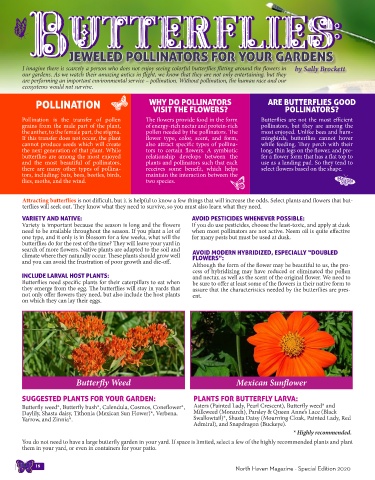
                          Butterfly Weed                                      Mexican Sunflower

        SUGGESTED PLANTS FOR YOUR GARDEN:                       PLANTS FOR BUTTERFLY LARVA:
        Butterfly weed*, Butterfly bush*, Calendula, Cosmos, Coneflower*,   Asters (Painted Lady, Pearl Crescent), Butterfly weed* and
        Daylily, Shasta daisy, Tithonia (Mexican Sun Flower)*, Verbena,   Milkweed (Monarch), Parsley & Queen Anne’s Lace (Black
        Yarrow, and Zinnia*.                                    Swallowtail)*, Shasta Daisy (Mourning Cloak, Painted Lady, Red
                                                                Admiral), and Snapdragon (Buckeye).
                                                                                                 * Highly recommended.
        You do not need to have a large butterfly garden in your yard. If space is limited, select a few of the highly recommended plants and plant
        them in your yard, or even in containers for your patio.


             18                                                               North Haven Magazine - Special Edition 2020

