


Page 28 - North Haven Magazine Issue 19 Summer 2021
P. 28
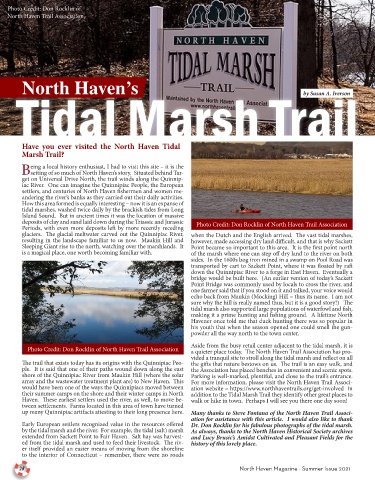
Photo Credit: Don Rocklin of
   North Haven Trail Association


        North Haven’s
       Tidal Marsh Trail
                                                                                                    by Susan A. Iverson


        Have  you  ever  visited  the  North  Haven  Tidal
        Marsh Trail?

           eing a local history enthusiast, I had to visit this site – it is the
        Bsetting of so much of North Haven’s story.  Situated behind Tar-
        get on Universal Drive North, the trail winds along the Quinnip-
        iac River.  One can imagine the Quinnipiac People, the European
        settlers, and centuries of North Haven fishermen and women me-
        andering the river’s banks as they carried out their daily activities.
        How this area formed is equally interesting – now it is an expanse of
        tidal marshes, washed twice daily by the brackish tides from Long
        Island Sound.  But in ancient times it was the location of massive
        deposits of clay and sand laid down during the Triassic and Jurassic   Photo Credit: Don Rocklin of North Haven Trail Association
        Periods, with even more deposits left by more recently receding
        glaciers.  The glacial meltwater carved out the Quinnipiac River,  when the Dutch and the English arrived.  The vast tidal marshes,
        resulting in the landscape familiar to us now.  Maukin Hill and  however, made accessing dry land difficult, and that is why Sackett
        Sleeping Giant rise to the north, watching over the marshlands.  It  Point became so important to this area.  It is the first point north
        is a magical place, one worth becoming familiar with.  of the marsh where one can step off dry land to the river on both
                                                               sides.  In the 1600s bog iron mined in a swamp on Pool Road was
                                                               transported by cart to Sackett Point, where it was floated by raft
                                                               down the Quinnipiac River to a forge in East Haven.  Eventually a
                                                               bridge would be built here.  (An earlier version of today’s Sackett
                                                               Point Bridge was commonly used by locals to cross the river, and
                                                               one farmer said that if you stood on it and talked, your voice would
                                                               echo back from Maukin (Mocking) Hill – thus its name.  I am not
                                                               sure why the hill is really named thus, but it is a good story!)   The
                                                               tidal marsh also supported large populations of waterfowl and fish,
                                                               making it a prime hunting and fishing ground.  A lifetime North
                                                               Havener once told me that duck hunting there was so popular in
                                                               his youth that when the season opened one could smell the gun-
                                                               powder all the way north to the town center.

                                                               Aside from the busy retail center adjacent to the tidal marsh, it is
          Photo Credit: Don Rocklin of North Haven Trail Association  a quieter place today.  The North Haven Trail Association has pro-
                                                               vided a tranquil site to stroll along the tidal marsh and reflect on all
        The trail that exists today has its origins with the Quinnipiac Peo-  the gifts that nature bestows on us.  The trail is an easy walk, and
        ple.  It is said that one of their paths wound down along the east  the Association has placed benches in convenient and scenic spots.
        shore of the Quinnipiac River from Maukin Hill (where the solar  Parking is well-marked, plentiful, and close to the trail’s entrance.
        array and the wastewater treatment plant are) to New Haven.  This  For more information, please visit the North Haven Trail Associ-
        would have been one of the ways the Quinnipiacs moved between  ation website – https://www.northhaventrails.org/get-involved  In
        their summer camps on the shore and their winter camps in North  addition to the Tidal Marsh Trail they identify other great places to
        Haven.  These earliest settlers used the river, as well, to move be-  walk or hike in town.  Perhaps I will see you there one day soon!
        tween settlements.  Farms located in this area of town have turned
        up many Quinnipiac artifacts attesting to their long presence here.  Many thanks to Steve Fontana of the North Haven Trail Associ-
                                                               ation for assistance with this article.  I would also like to thank
        Early European settlers recognized value in the resources offered  Dr. Don Rocklin for his fabulous photographs of the tidal marsh.
        by the tidal marsh and the river.  For example, the tidal (salt) marsh  As always, thanks to the North Haven Historical Society archives
        extended from Sackett Point to Fair Haven.  Salt hay was harvest-  and Lucy Brusic’s Amidst Cultivated and Pleasant Fields for the
        ed from the tidal marsh and used to feed their livestock.  The riv-  history of this lovely place.
        er itself provided an easier means of moving from the shoreline
        to the interior of Connecticut – remember, there were no roads

       28                                                                      North Haven Magazine - Summer Issue 2021

