


Page 18 - North Haven Magazine Issue 9 Summer 2019
P. 18
Tips for Healthier                                 by Sally Brockett
       Yards Gardens
       Yards Gardens
                                     & &


        Information about the hazards of pesticides, pollutants, concerns about food sources,
        and invasive plants and insects, can cause the homeowner to wonder how he can have a
        healthy yard and garden. It is possible to achieve this, but it is important to learn some
        tips and techniques that will make things easier. Let’s take a look at some of these options.

                      Reduce Lawn Areas                                             Gardening
        Decrease the amount of lawn grass in order to reduce mainte-  Are you starting a new garden are that is currently grass, or, weeds?
        nance and conserve water.                               No need to spray with a chemical herbicide. First, mow the plant
        Create more natural space in your landscape: an area with shrubs   material to a low level, then cover with cardboard or newspaper.
                                                                Hose the newspaper with water to help hold it down, while you
        to attract birds, a butterfly garden, or a wildflower meadow area.  cover with mulch or stone.
        Xeriscape gardening conserves both water and your time and
        energy, by using drought tolerant   plants, and mulch to mini-
        mize weeds and reduce water needs. Many of the drought tolerant
        plants are attractive to pollinators, so you will also have a pollina-
        tor garden at the same time!
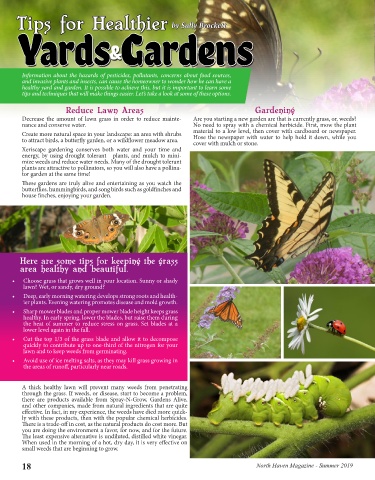
        These gardens are truly alive and entertaining as you watch the
        butterflies, hummingbirds, and song birds such as goldfinches and
        house finches, enjoying your garden.


       Here are some tips for keeping the grass
       area healthy and beautiful.
     •   Choose grass that grows well in your location. Sunny or shady
         lawn? Wet, or sandy, dry ground?
     •   Deep, early morning watering develops strong roots and health-
         ier plants. Evening watering promotes disease and mold growth.
     •   Sharp mower blades and proper mower blade height keeps grass
         healthy. In early spring, lower the blades, but raise them during
         the heat of summer to reduce stress on grass. Set blades at a
         lower level again in the fall.
     •   Cut the top 1/3 of the grass blade and allow it to decompose
         quickly to contribute up to one-third of the nitrogen for your
         lawn and to keep weeds from germinating.
     •   Avoid use of ice melting salts, as they may kill grass growing in
         the areas of runoff, particularly near roads.


        A thick healthy lawn will prevent many weeds from penetrating
        through the grass. If weeds, or disease, start to become a problem,
        there are products available from Spray-N-Grow, Gardens Alive,
        and other companies, made from natural ingredients that are quite
        effective. In fact, in my experience, the weeds have died more quick-
        ly with these products, then with the popular chemical herbicides.
        There is a trade-off in cost, as the natural products do cost more. But
        you are doing the environment a favor, for now, and for the future.
        The least expensive alternative is undiluted, distilled white vinegar.
        When used in the morning of a hot, dry day, it is very effective on
        small weeds that are beginning to grow.

        18                                                                           North Haven Magazine - Summer 2019

