


Page 19 - North Haven Magazine Issue 32 Winter 2024
P. 19
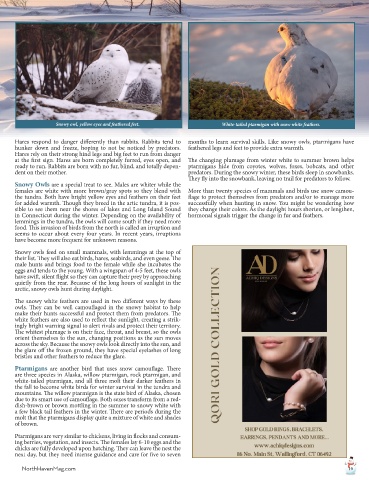
Snowy owl, yellow eyes and feathered feet.            White-tailed ptarmigan with snow white feathers.

      Hares respond to danger differently than rabbits. Rabbits tend to  months to learn survival skills. Like snowy owls, ptarmigans have
      hunker  down  and  freeze,  hoping  to  not  be  noticed  by  predators.  feathered legs and feet to provide extra warmth.
      Hares rely on their strong hind legs and big feet to run from danger
      at the first sign. Hares are born completely furred, eyes open, and  The changing plumage from winter white to summer brown helps
      ready to run. Rabbits are born with no fur, blind, and totally depen-  ptarmigans hide from coyotes, wolves, foxes, bobcats, and other
      dent on their mother.                                    predators. During the snowy winter, these birds sleep in snowbanks.
                                                               They fly into the snowbank, leaving no trail for predators to follow.
      Snowy Owls are a special treat to see. Males are whiter while the
      females are white with more brown/gray spots so they blend with  More than twenty species of mammals and birds use snow camou-
      the tundra. Both have bright yellow eyes and feathers on their feet  flage to protect themselves from predators and/or to manage more
      for added warmth. Though they breed in the artic tundra, it is pos-  successfully when hunting in snow. You might be wondering how
      sible to see them near the shores of lakes and Long Island Sound  they change their colors. As the daylight hours shorten, or lengthen,
      in Connecticut during the winter. Depending on the availability of  hormonal signals trigger the change in fur and feathers.
      lemmings in the tundra, the owls will come south if they need more
      food. This invasion of birds from the north is called an irruption and
      seems to occur about every four years. In recent years, irruptions
      have become more frequent for unknown reasons.
      Snowy owls feed on small mammals, with lemmings at the top of
      their list. They will also eat birds, hares, seabirds, and even geese. The
      male hunts and brings food to the female while she incubates the
      eggs and tends to the young. With a wingspan of 4-5 feet, these owls
      have swift, silent flight so they can capture their prey by approaching
      quietly from the rear. Because of the long hours of sunlight in the
      arctic, snowy owls hunt during daylight.
      The snowy white feathers are used in two different ways by these
      owls. They can be well camouflaged in the snowy habitat to help
      make their hunts successful and protect them from predators. The
      white feathers are also used to reflect the sunlight, creating a strik-
      ingly bright warning signal to alert rivals and protect their territory.
      The whitest plumage is on their face, throat, and breast, so the owls
      orient themselves to the sun, changing positions as the sun moves
      across the sky. Because the snowy owls look directly into the sun, and
      the glare off the frozen ground, they have special eyelashes of long
      bristles and other feathers to reduce the glare.
      Ptarmigans are another bird that uses snow camouflage. There
      are three species in Alaska, willow ptarmigan, rock ptarmigan, and
      white-tailed ptarmigan, and all three molt their darker feathers in
      the fall to become white birds for winter survival in the tundra and
      mountains. The willow ptarmigan is the state bird of Alaska, chosen
      due to its smart use of camouflage. Both sexes transform from a red-
      dish-brown or brown mottling in the summer to snowy white with
      a few black tail feathers in the winter. There are periods during the
      molt that the ptarmigans display quite a mixture of white and shades
      of brown.
      Ptarmigans are very similar to chickens, living in flocks and consum-
      ing berries, vegetation, and insects. The females lay 6-10 eggs and the
      chicks are fully developed upon hatching. They can leave the nest the
      next day, but they need intense guidance and care for five to seven

        NorthHavenMag.com                                                                                          19

