


Page 18 - North Haven Magazine Issue 32 Winter 2024
P. 18
C
                                                                                                  by Sally Brockett
        S Snow Camouflage
                 now
                                                     amouflage


              FOR HIDING AND HUNTING


          any animals are predators, but they are also prey to other animals. Camouflage is vital for their survival and continuation of the species. It
     Menables them to hide in their environments while hunting to improve their chances of success. It also helps them hide from the predators
     that are hunting them. Some animals use snow camouflage during the winter because their natural coloring during other seasons would make
     them stand out in the winter environment. Let’s learn about some of these mammals and birds that can change their colors!

     The Artic Fox lives in the tundra or moun-  cludes several different species. You may be  are a smaller species of the more common
     tains of the Artic region. These foxes have  familiar with ferrets, which are distant cous-  long-tailed weasel. Ermines molt and grow
     adapted for survival in the frigid environ-  ins of weasels, but belong to the same scien-  pristine white fur for the winter regardless of
     ment. They have short, rounded ears, short  tific family. Weasels are small mammals with  where they live. The wealthy and royalty used
     muzzles or noses, and fur on the soles of their  an elongated, slender body, rounded ears,  ermine fur for clothing and décor. Both wea-
     paws. Like a polar bear, their skin is dark to  a pointy nose, and large eyes. They live in  sels and ermines, with their small furry bod-
     help absorb and retain the heat. Their furry  woodlands, stone walls, hedgerows, and tall  ies and big eyes, are cute and fun to watch,
     tails are about twelve inches long and are  grass in many regions of the world. They are  but they will never be nice pets due to their
     used to wrap around their bodies for warmth  very agile and active with a very high meta-  vicious hunting habits.
     while sleeping.                       bolic rate. They need to kill and eat a quarter
                                           to a third of their body weight each day. They  Snowshoe Hares are another mammal
                                           are very efficient hunters and eat small mam-  well-known for its use of snow camouflage.
                                           mals such as mice, voles, lemmings, birds,  Hares  and  rabbits  are  related  but  there  are
                                           young rabbits, and eggs. Farmers perceive  differences in appearance and behavior.
                                           them as friend and foe because they manage  Hares are larger than rabbits and have much
                                           the population of mice and other vermin that  bigger hind legs and toes, hence the name
                                           eat the farmers’ grains, but they also create  “snowshoe”. The powerful hind legs assist
                                           havoc in the hen house.                them when leaping through the snow to es-
                                                                                  cape from  predators. The  extra-large  toes,
                                                                                  with added fur covering, is another adapta-
                                                                                  tion that helps  them power  through heavy
                                                                                  snow. The hares are white in the winter to
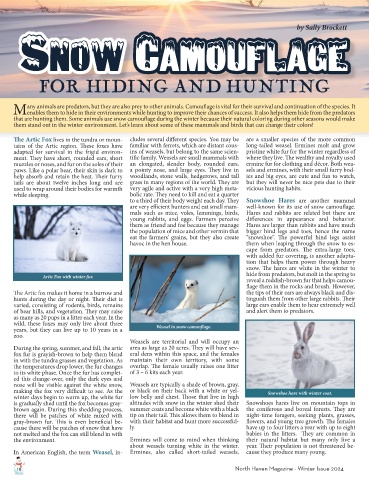
               Artic Fox with winter fur.                                         hide from predators, but molt in the spring to
                                                                                  reveal a reddish-brown fur that helps camou-
                                                                                  flage them in the rocks and brush. However,
     The Artic fox makes it home in a burrow and                                  the tips of their ears are always black and dis-
     hunts during the day or night. Their diet is                                 tinguish them from other large rabbits. Their
     varied, consisting of rodents, birds, remains                                large ears enable them to hear extremely well
     of bear kills, and vegetation. They may raise                                and alert them to predators.
     as many as 20 pups in a litter each year. In the
     wild, these foxes may only live about three    Weasel in snow camouflage.
     years, but they can live up to 10 years in a
     zoo.
                                           Weasels are territorial and will occupy an
     During the spring, summer, and fall, the artic  area as large as 20 acres. They will have sev-
     fox fur is grayish-brown to help them blend  eral dens within this space, and the females
     in with the tundra grasses and vegetation. As  maintain their own territory, with some
     the temperatures drop lower, the fur changes  overlap. The female usually raises one litter
     to its white phase. Once the fur has complet-  of 3 – 6 kits each year.
     ed this change-over, only the dark eyes and
     nose will be visible against the white snow,  Weasels are typically a shade of brown, gray,
     making the fox very difficult to see. As the  or black on their back with a white or yel-  Snowshoe hare with winter coat.
     winter days begin to warm up, the white fur  low belly and chest. Those that live in high
     is gradually shed until the fox becomes gray-  altitudes with snow in the winter shed their  Snowshoes hares live on mountain tops in
     brown again. During this shedding process,  summer coats and become white with a black  the coniferous  and boreal  forests. They are
     there will be patches of white mixed with  tip on their tail. This allows them to blend in  night-time foragers, seeking plants, grasses,
     gray-brown fur. This is even beneficial be-  with their habitat and hunt more successful-  flowers, and young tree growth. The females
     cause there will be patches of snow that have  ly.                           have up to four litters a year with up to eight
     not melted and the fox can still blend in with                               babies in the litters.  They are common in
     the environment.                      Ermines will come to mind when thinking  their natural habitat but many only live a
                                           about weasels turning white in the winter.  year. Their population is not threatened be-
     In American English, the term Weasel, in-  Ermines, also called short-tailed weasels,  cause they produce many young.


      18                                                                      North Haven Magazine - Winter Issue 2024

