


Page 18 - North Haven Magazine Issue 29 Summer 2023
P. 18
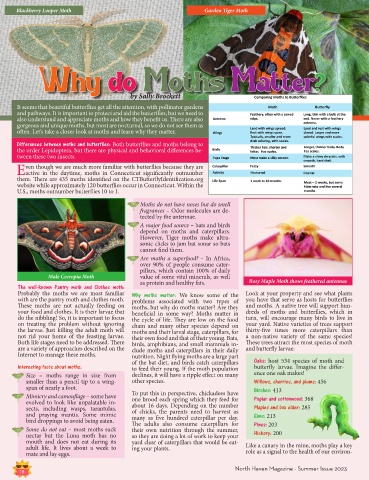
Blackberry Looper Moth                                        Garden Tiger Moth


              W         h    y d         o      M       o    ths            M        at      t  e   r?
              Why do Moths Matter?


                                            by Sally Brockett

       It seems that beautiful butterflies get all the attention, with pollinator gardens
       and pathways. It is important to protect and aid the butterflies, but we need to
       also understand and appreciate moths and how they benefit us. There are also
       gorgeous and unique moths, but most are nocturnal, so we do not see them as
       often. Let’s take a closer look at moths and learn why they matter.
       Differences between moths and butterflies: Both butterflies and moths belong to
       the order Lepidoptera, but there are physical and behavioral differences be-
       tween these two insects.
         ven though we are much more familiar with butterflies because they are
      Eactive in the daytime, moths in Connecticut significantly outnumber
       them. There are 435 moths identified on the CTButterflyIdentification.org
       website while approximately 120 butterflies occur in Connecticut. Within the
       U.S., moths outnumber butterflies 10 to 1.

                                               Moths do not have noses but do smell
                                               fragrances – Odor molecules are de-
                                               tected by the antennae.
                                               A major food source – bats and birds
                                               depend on moths and caterpillars.
                                               However,  Tiger  moths  make  ultra-
                                               sonic clicks to jam bat sonar so bats
                                               cannot find them.
                                               Are moths a superfood? – In Africa,
                                               over 90% of people consume cater-
                                               pillars, which contain 100% of daily
                 Male Cecropia Moth            value of some vital minerals, as well
                                               as protein and healthy fats.       Rosy Maple Moth shows feathered antennae
       The  well-known  Pantry  moth  and  Clothes  moth:
       Probably the moths we are most familiar   Why moths matter:  We know some of the   Look at your property and see what plants
       with are the pantry moth and clothes moth.   problems associated with two types of   you have that serve as hosts for butterflies
       These moths are not actually feeding on   moths, but why do moths matter? Are they   and moths. A native tree will support hun-
       your food and clothes. It is their larvae that   beneficial in some way? Moths matter in   dreds  of  moths  and  butterflies,  which  in
       do the nibbling! So, it is important to focus   the cycle of life. They are low on the food   turn, will encourage many birds to live in
       on treating the problem without ignoring   chain and many other species depend on   your yard. Native varieties of trees support
       the larvae. Just killing the adult moth will   moths and their larval stage, caterpillars, for   thirty-five times  more  caterpillars  than
       not rid your home of the feasting larvae.   their own food and that of their young. Bats,   a non-native variety of the same species!
       Both life stages need to be addressed. There   birds, amphibians, and small mammals in-  These trees attract the most species of moth
       are a variety of approaches described on the   clude moths and caterpillars in their daily   and butterfly larvae:
       Internet to manage these moths.      nutrition. Night flying moths are a large part
                                            of the bat diet, and birds catch caterpillars   Oaks:  host  534  species  of  moth  and
       Interesting facts about moths:       to feed their young. If the moth population   butterfly larvae. Imagine the differ-
          Size  –  moths  range  in  size  from   declines, it will have a ripple effect on many   ence one oak makes!
          smaller than a pencil tip to a wing-  other species.                      Willows, cherries, and plums: 456
          span of nearly a foot.                                                    Birches: 413
          Mimicry and camouflage – some have   To put this in perspective, chickadees have   Poplar and cottonwood: 368
                                            one brood each spring which they feed for
          evolved to look like unpalatable in-  about 16 days. Depending on the number
          sects, including wasps, tarantulas,   of chicks, the parents need to harvest as   Maples and box elder: 285
          and  praying  mantis.  Some  mimic   many as five hundred caterpillar per day.   Elms: 213
          bird droppings to avoid being eaten.  The adults also consume caterpillars for   Pines: 203
          Some do not eat – most moths suck   their own nutrition through the summer,
          nectar but the Luna moth has no   so they are doing a lot of work to keep your   Hickory: 200
          mouth and does not eat during its   yard clear of caterpillars that would be eat-
          adult life. It lives about a week to   ing your plants.                Like a canary in the mine, moths play a key
          mate and lay eggs.                                                     role as a signal to the health of our environ-

                                                                              North Haven Magazine - Summer Issue 2023
       18

