


Page 18 - North Haven Magazine Issue 28 Spring 2023
P. 18
by Sally Brockett


      Soap has a long history, dating back to 2800 BC and ancient Babylon. The Babylonians were the first to master the art of soap making, using fats
      boiled with ashes. As time passed, other civilizations developed their own method of making soap. The ancient Egyptians used animal and veg-
      etable oils with alkaline salts to create a soap mixture. In 600 BC the Phoenicians used goat’s tallow (fat) and wood ashes to make soap. During
      these times, the soap was not made for personal use, but it was used for cleaning cooking utensils or other goods, and for some medicinal purposes.
                                            families had their own lye stones and ash bar-  no longer used for soap making. This was the
                                            rels, called an “ash hopper” or “leach barrel.” A   case with the lye stone from the Brockett family
                                            circular groove and spout were carved into the   farm. Richard (Dick) Brockett enjoyed saving
                                            lye stone. The barrel was placed into the groove   items from the past so history and culture could
                                            on the lye stone and ashes from hard woods   be shared with future generations. The family
                                            such as hickory, maple, and ash were collect-  lye stone occupied various places around the
                                            ed in the barrel. Wet lime was tamped into the   family homes over the years, but Dick never
                                            barrel of ashes and water was poured into the   allowed it to be discarded. To ensure that the
                                            barrel. The water “leached” through the barrel   family lye stone did not become lost to history,
                                            and drained out as lye. The lye solution was col-  his son Walt decided to move the stone from
                                                                                 his parent’s house to his own yard. Due to the
                                                                                 size and weight of the stone, this required plan-
           Positioning the lye stone for display.                                ning and use of his John Deere tractor.
         s the years passed, soap was made by a                                  It  was  decided  that  the  lye  stone  would  be
      Asmall group of soap makers using an ex-                                   placed in the berry garden (planted for the
      clusive technique, and in some areas, there                                birds) located in the backyard. To easily see the
      was a monopoly on the business. Soap was                                   carved circle and spout, the stone was to be set
      very expensive during this period. In 1791, a                              on an upright angle. A large stone would be
      Frenchman named LeBlanc discovered a new                                   placed behind it to support the lye stone in the
      chemical process that allowed soap to become                               upright position.
      less expensive.
                                                 Bracing stone with another stone.
      Modern soap making began in the early 1800s
      when another Frenchman used glycerin, fats,
      and acid. Soap became less expensive and more   lected as it dripped from the spout in the stone.
      available. Since that time there have been no   It was important to get the lye exactly right,
      major discoveries that impacted soap making.   so it was poured over fresh ashes in the barrel
      However, as the science of chemistry evolved,   at intervals to strengthen it. The lye was con-
      soaps were gradually differentiated for use in   sidered exactly right if an egg or potato could
      laundry and personal bathing. Currently we   float in it. The lye was now boiled with animal
      have a vast variety of soaps, each with a specific   fat in a big pot and sassafras was stirred into it
      recipe and purpose, including those for wash-  to provide a fresh scent. This mixture became
      ing your pets, cars, carpets, clothes, and your   soap, which was then “seasoned” for ten weeks
      child!                                before use. Fall was a favored time for making   Brockett lye stone in its new location.
                                            soap because the farm animals were butchered
      The slipperiness of soap lowers the surface   for meat and the fat could be collected for mak-
      tension of the water you are mixing it with.   ing the soap.               The tractor was used to dislodge the lye stone
      Rubbing your hands together while washing                                  from its place near the kitchen door of the fam-
      allows dirt to temporarily bond with the water                             ily home. The forks on the tractor carried the
      and soap and get washed away. The same pro-                                stone from its long-time resting spot to the new
      cess occurs with most viruses and bacteria that                            location in the berry garden. Using braces and
      might be lingering on your hands. Soap does                                ropes, the stone was carefully set into the gar-
      not kill these bugs— they become slippery and                              den at the appropriate angle. A smaller stone
      are lifted from your skin, mixed with water, and                           was set behind it to keep it upright.
      sent down the drain. This chemical and me-
      chanical reaction makes soap and water more                                The lye stone is now enjoyed by Walt and his
      effective,  in general,  than  waterless  sanitizing                       family, and others who visit. It has become a
      gels.                                                                      conversation piece because many are not fa-
                                                                                 miliar with lye stones and how soap used to
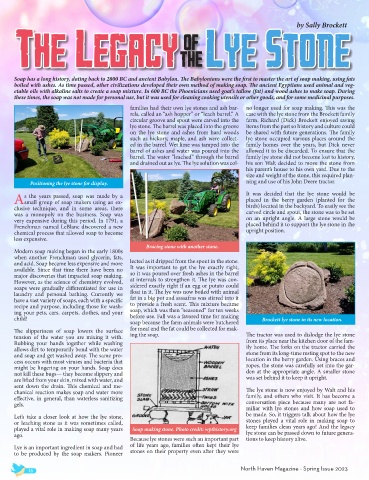
      Let’s take a closer look at how the lye stone,                             be made. So, it triggers talk about how the lye
      or leaching stone as it was sometimes called,                              stones  played a  vital  role  in  making soap to
      played a vital role in making soap many years   Soap making stone. Photo credit: wpthistory.org  keep families clean years ago! And the legacy
      ago.                                                                       lye stone can be passed down to future genera-
                                            Because lye stones were such an important part   tions to keep history alive.
      Lye is an important ingredient in soap and had   of life years ago, families often kept their lye
      to be produced by the soap makers. Pioneer   stones on their property even after they were

                                                                                North Haven Magazine - Spring Issue 2023
          18

