


Page 9 - North Haven Magazine Issue 25 Autumn 2022
P. 9
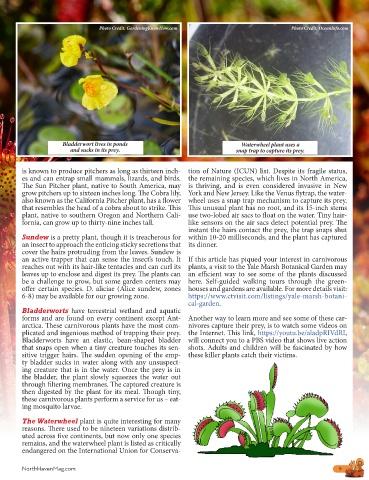
Photo Credit: GardeningKnowHow.com                             Photo Credit: OceanInfo.com


                     Bladderwort lives in ponds                                 Waterwheel plant uses a
                        and sucks in its prey.                                snap trap to capture its prey.


        is known to produce pitchers as long as thirteen inch- tion of Nature (ICUN) list. Despite its fragile status,
        es and can entrap small mammals, lizards, and birds.  the remaining species, which lives in North America,
        The Sun Pitcher plant, native to South America, may  is thriving, and is even considered invasive in New
        grow pitchers up to sixteen inches long. The Cobra lily,  York and New Jersey. Like the Venus flytrap, the water-
        also known as the California Pitcher plant, has a flower  wheel uses a snap trap mechanism to capture its prey.
        that resembles the head of a cobra about to strike. This  This unusual plant has no root, and its 15-inch stems
        plant, native to southern Oregon and Northern Cali- use two-lobed air sacs to float on the water. Tiny hair-
        fornia, can grow up to thirty-nine inches tall.        like sensors on the air sacs detect potential prey. The
                                                               instant the hairs contact the prey, the trap snaps shut
        Sundew is a pretty plant, though it is treacherous for  within 10-20 milliseconds, and the plant has captured
        an insect to approach the enticing sticky secretions that  its dinner.
        cover the hairs protruding from the leaves. Sundew is
        an active trapper that can sense the insect’s touch. It  If this article has piqued your interest in carnivorous
        reaches out with its hair-like tentacles and can curl its  plants, a visit to the Yale Marsh Botanical Garden may
        leaves up to enclose and digest its prey. The plants can  an efficient way to see some of the plants discussed
        be a challenge to grow, but some garden centers may  here. Self-guided walking tours through the green-
        offer certain species. D. aliciae (Alice sundew, zones  houses and gardens are available. For more details visit:
        6-8) may be available for our growing zone.            https://www.ctvisit.com/listings/yale-marsh-botani-
                                                               cal-garden.
        Bladderworts  have  terrestrial  wetland  and  aquatic
        forms and are found on every continent except Ant- Another way to learn more and see some of these car-
        arctica. These carnivorous plants have the most com- nivores capture their prey, is to watch some videos on
        plicated and ingenious method of trapping their prey.  the Internet. This link, https://youtu.be/aladpRIVdRI,
        Bladderworts  have  an  elastic,  bean-shaped  bladder  will connect you to a PBS video that shows live action
        that snaps open when a tiny creature touches its sen- shots. Adults and children will be fascinated by how
        sitive trigger hairs. The sudden opening of the emp- these killer plants catch their victims.
        ty bladder sucks in water along with any unsuspect-
        ing creature that is in the water. Once the prey is in
        the bladder, the plant slowly squeezes the water out
        through filtering membranes. The captured creature is
        then digested by the plant for its meal. Though tiny,
        these carnivorous plants perform a service for us – eat-
        ing mosquito larvae.

        The Waterwheel plant is quite interesting for many
        reasons. There used to be nineteen variations distrib-
        uted across five continents, but now only one species
        remains, and the waterwheel plant is listed as critically
        endangered on the International Union for Conserva-


        NorthHavenMag.com                                                                                       9

