


Page 8 - North Haven Magazine Issue 25 Autumn 2022
P. 8
by Sally Brockett


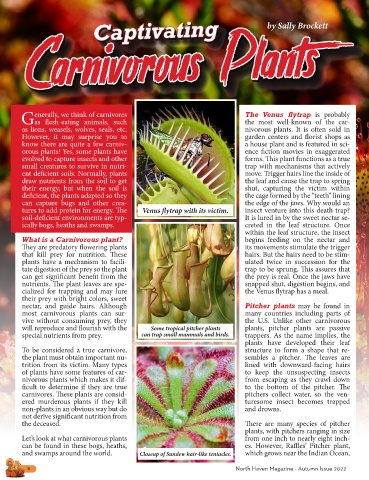
            enerally, we think of carnivores                                     The  Venus  flytrap is probably
        Gas flesh-eating animals, such                                           the most well-known of the car-
        as lions, weasels, wolves, seals, etc.                                   nivorous plants. It is often sold in
        However, it may surprise you to                                          garden centers and florist shops as
        know there are quite a few carniv-                                       a house plant and is featured in sci-
        orous plants! Yes, some plants have                                      ence fiction movies in exaggerated
        evolved to capture insects and other                                     forms. This plant functions as a true
        small creatures to survive in nutri-                                     trap with mechanisms that actively
        ent deficient soils. Normally, plants                                    move. Trigger hairs line the inside of
        draw nutrients from the soil to get                                      the leaf and cause the trap to spring
        their energy, but when the soil is                                       shut, capturing the victim within
        deficient, the plants adapted so they                                    the cage formed by the “teeth” lining
        can capture bugs and other crea-                                         the edge of the jaws. Why would an
        tures to add protein for energy. The    Venus flytrap with its victim.   insect venture into this death trap?
        soil-deficient environments are typ-                                     It is lured in by the sweet nectar se-
        ically bogs, heaths and swamps.                                          creted  in the leaf structure.  Once
                                                                                 within the leaf structure, the insect
        What is a Carnivorous plant?                                             begins feeding on the nectar and
        They are predatory flowering plants                                      its movements stimulate the trigger
        that kill prey for  nutrition.  These                                    hairs. But the hairs need to be stim-
        plants have a mechanism to facili-                                       ulated twice in succession for the
        tate digestion of the prey so the plant                                  trap to be sprung. This assures that
        can get significant benefit from the                                     the prey is real. Once the jaws have
        nutrients. The plant leaves are spe-                                     snapped shut, digestion begins, and
        cialized for trapping and may lure                                       the Venus flytrap has a meal.
        their prey with bright colors, sweet
        nectar,  and  guide  hairs.  Although                                    Pitcher  plants may be found in
        most carnivorous plants can sur-                                         many countries including parts of
        vive without consuming prey, they                                        the U.S. Unlike other carnivorous
        will reproduce and flourish with the      Some tropical pitcher plants   plants, pitcher plants are passive
        special nutrients from prey.           can trap small mammals and birds.  trappers. As the name implies, the
                                                                                 plants have developed their leaf
        To be considered a true carnivore,                                       structure to form a shape that re-
        the plant must obtain important nu-                                      sembles a pitcher. The leaves are
        trition from its victim. Many types                                      lined with downward-facing hairs
        of plants have some features of car-                                     to keep the unsuspecting insects
        nivorous plants which makes it dif-                                      from escaping as  they crawl down
        ficult to determine if they are true                                     to the bottom of the pitcher. The
        carnivores. These plants are consid-                                     pitchers  collect water, so the ven-
        ered murderous plants if they kill                                       turesome insect becomes trapped
        non-plants in an obvious way but do                                      and drowns.
        not derive significant nutrition from
        the deceased.                                                            There are many species of pitcher
                                                                                 plants, with pitchers ranging in size
        Let’s look at what carnivorous plants                                    from one inch to nearly eight inch-
        can be found in these bogs, heaths,                                      es.  However,  Raffles’  Pitcher  plant,
        and swamps around the world.           Closeup of Sundew hair-like tentacles.  which grows near the Indian Ocean,


          8                                                                   North Haven Magazine - Autumn Issue 2022

