


Page 20 - North Haven Magazine Issue 25 Autumn 2022
P. 20
by Sally Brockett


              hen you hear the word “lupin”, also spelled, and pronounced “lupine”, can you envision this beau-
        Wtiful flower in your mind? Would you recognize it growing in a garden or along the road? Do you
        know that lupins used to be seen commonly in North Haven? Let’s learn more about these lovely flowers
        and maybe even consider growing them in gardens and meadows, or along the road.


        Origin of the name
        The genus name, lupin, is derived from the Latin word
        for “wolf” which is “lupus”. Long ago it was thought
        that the lupin drained away, or “wolfed down the min-
        erals in the soil where they were growing. It was later
        found that lupins actually are nitrogen-fixers just like
        other plants in the pea family. In fact, some species of
        lupins are grown specifically for commercial green ma-
        nure.

        What do they look like?
        Lupins are available as perennials, which means they
        emerge in the spring, grow, and blossom during the
        early summer, and die back in the fall. They are also
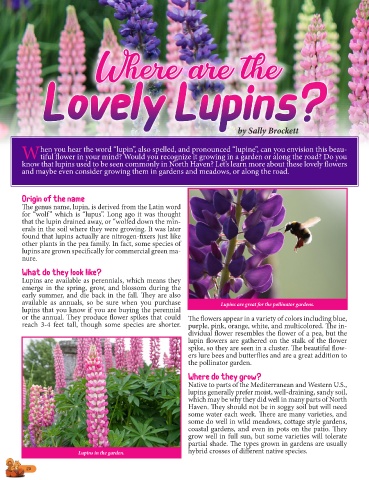
        available as annuals, so be sure when you purchase               Lupins are great for the pollinator gardens.
        lupins that you know if you are buying the perennial
        or the annual. They produce flower spikes that could   The flowers appear in a variety of colors including blue,
        reach 3-4 feet tall, though some species are shorter.   purple, pink, orange, white, and multicolored. The in-
                                                               dividual flower resembles the flower of a pea, but the
                                                               lupin flowers are gathered on the stalk of the flower
                                                               spike, so they are seen in a cluster. The beautiful flow-
                                                               ers lure bees and butterflies and are a great addition to
                                                               the pollinator garden.

                                                               Where do they grow?
                                                               Native to parts of the Mediterranean and Western U.S.,
                                                               lupins generally prefer moist, well-draining, sandy soil,
                                                               which may be why they did well in many parts of North
                                                               Haven. They should not be in soggy soil but will need
                                                               some water each week. There are many varieties, and
                                                               some do well in wild meadows, cottage style gardens,
                                                               coastal gardens, and even in pots on the patio. They
                                                               grow well in full sun, but some varieties will tolerate
                                                               partial shade. The types grown in gardens are usually

                           Lupins in the garden.               hybrid crosses of different native species.

          20

