


Page 22 - North Haven Magazine Issue 24 Summer 2022
P. 22
A Moving Experience:

      Brockett Farm Museum
                                                                                                     by Sally Brockett


        Richard (Dick) Brockett, a long-time member of the North Haven Historical So-  Leaves North Haven
        ciety and the Mayflower Society, was known for his interest in history. However,
        many may not have known that he was a collector of items from the past. He had
        the foresight to recognize that as things change and develop, the past can easily be
        lost to future generations. This understanding and interest resulted in the creation
        of the Brockett Family Farm Museum.


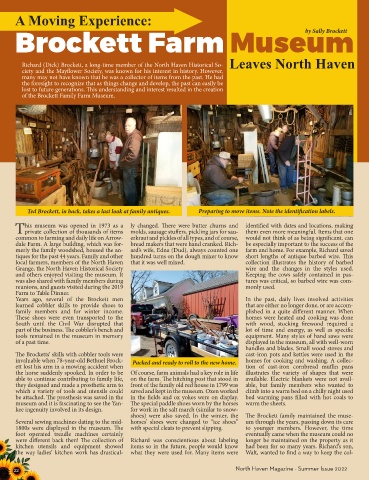
          Ted Brockett, in back, takes a last look at family antiques.  Preparing to move items. Note the identification labels.

         his museum was opened in 1973 as a  ly changed. There were butter churns and  identified with dates and locations, making
      Tprivate collection of thousands of items  molds, sausage stuffers, pickling jars for sau-  them even more meaningful. Items that one
      common to farming and daily life on Arrow-  erkraut and pickles of all types, and of course,  would not think of as being significant, can
      dale Farm. A large building, which was for-  bread makers that were hand cranked. Rich-  be especially important to the success of the
      merly the family woodshed, housed the an-  ard’s wife, Edna (Dud), always counted one  farm and home. For example, Richard saved
      tiques for the past 44 years. Family and other  hundred turns on the dough mixer to know  short lengths of antique barbed wire. This
      local farmers, members of the North Haven  that it was well mixed.         collection illustrates the history of barbed
      Grange, the North Haven Historical Society                                 wire and the changes in the styles used.
      and others enjoyed visiting the museum. It                                 Keeping the cows safely contained in pas-
      was also shared with family members during                                 tures was critical, so barbed wire was com-
      reunions, and guests visited during the 2019                               monly used.
      Farm to Table Dinner.
      Years ago, several of the Brockett men                                     In the past, daily lives involved activities
      learned cobbler  skills  to  provide  shoes  to                            that are either no longer done, or are accom-
      family members and for winter income.                                      plished in a quite different manner. When
      These shoes were even transported to the                                   homes were heated and cooking was done
      South until the Civil War disrupted that                                   with wood, stocking firewood required a
      part of the business. The cobbler’s bench and                              lot of time and energy, as well as specific
      tools remained in the museum in memory                                     equipment. Many styles of hand saws were
      of a past time.                                                            displayed in the museum, all with well-worn
                                                                                 handles and blades. Small wood stoves and
      The Brocketts’ skills with cobbler tools were                              cast-iron pots and kettles were used in the
      invaluable when 78-year-old Bethuel Brock-  Packed and ready to roll to the new home.  homes for cooking and washing. A collec-
      ett lost his arm in a mowing accident when                                 tion of cast-iron cornbread muffin pans
      the horse suddenly spooked. In order to be  Of course, farm animals had a key role in life  illustrates the variety of shapes that were
      able to continue contributing to family life,  on the farm. The hitching post that stood in  available. Electric blankets were not avail-
      they designed and made a prosthetic arm to  front of the family old red house in 1799 was  able, but family members who wanted to
      which a variety of tools and utensils could  saved and kept in the museum. Oxen worked  climb into a warm bed on a chilly night used
      be attached. The prosthesis was saved in the  in the fields and ox yokes were on display.  bed warming pans filled with hot coals to
      museum and it is fascinating to see the Yan-  The special paddle shoes worn by the horses  warm the sheets.
      kee ingenuity involved in its design.  for work in the salt march (similar to snow-
                                            shoes)  were also saved. In the  winter, the  The Brockett family maintained the muse-
      Several sewing machines dating to the mid-  horses’  shoes  were  changed  to “ice  shoes”  um through the years, passing down its care
      1800s were displayed in the museum. The  with special cleats to prevent slipping.   to younger members. However, the time
      foot operated treadle machines certainly                                   eventually came when the museum could no
      were different back then! The collection of  Richard was conscientious about labeling  longer be maintained on the property as it
      kitchen utensils and equipment showed  items so in the future, people would know  had been for so many years. Richard’s son,
      the way ladies’ kitchen work has drastical-  what they were used for. Many items were  Walt, wanted to find a way to keep the col-


                                                                              North Haven Magazine - Summer Issue 2022
      22

