


Page 6 - North Haven Magazine Issue 22 Winter 2022
P. 6
by Sally Brockett


                         Get to Know Our Unique Mascot!

     With the naming of a new mascot for the North Haven school community, it would be
     good for residents to know more about the bird that represents our schools. There are
     many interesting facts about these birds that will be fun to know.
                                                                                                    Photo Credit: BirdPhotos.com
         ightjars are small to large birds found around the world except in the artic areas.
     NNighthawks  are  a  North  American  species  of  nightjars,  and  they  can  be  found  in  a
     variety of habitats including deserts, grasslands, forests, and coastal sand dunes. There are two
     nighthawks, the common nighthawk, with a length of 9 inches and wingspan of 23 inches, and
     found throughout the U.S., and the lesser nighthawk, which is 8 inches long with a wingspan
     of 21 inches, usually only found in the southwest and Central America.

     Is a nighthawk really a hawk?         These birds have tiny bills as it is not used for
     Nighthawks are not hawks despite their name.   feeding, but their eyes are large for flights in
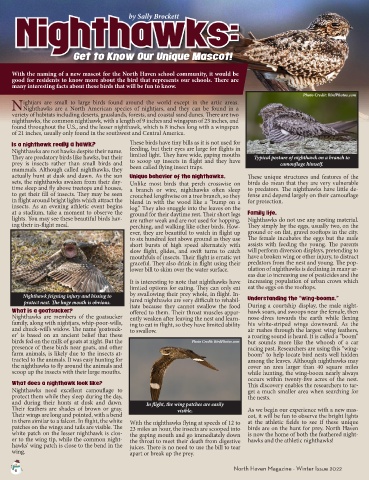
     They are predatory birds like hawks, but their   limited light. They have wide, gaping mouths   Typical posture of nighthawk on a branch to
     prey is insects rather  than small birds  and   to scoop up insects in flight and they have   camouflage himself.
     mammals. Although called nighthawks, they   been called flying insect traps.
     actually hunt at dusk and dawn. As the sun  Unique behavior of the nighthawks.   These unique structures and features of the
     sets, the nighthawks awaken from their day-  Unlike most birds that perch crosswise on  birds do mean that they are very vulnerable
     time sleep and fly above treetops and houses,   a branch or wire, nighthawks often sleep  to predators. The nighthawks have little de-
     to get their fill of insects. They may be seen   crouched lengthwise on a tree branch, so they  fense and depend largely on their camouflage
     in flight around bright lights which attract the   blend in  with the  wood like  a “bump  on  a  for protection.
     insects. As an evening athletic event begins   log.” They also snuggle into the leaves on the
     at a stadium, take a moment to observe the   ground for their daytime rest. Their short legs   Family life.
     lights. You may see these beautiful birds hav-  are rather weak and are not used for hopping,  Nighthawks do not use any nesting material.
     ing their in-flight meal.             perching, and walking like other birds. How-  They simply lay the eggs, usually two, on the
                                           ever, they are beautiful to watch in flight up  ground or on flat, gravel rooftops in the city.
                                           to six hundred feet above ground as they use  The female incubates the eggs but the male
                                           short bursts of high speed alternately with  assists with feeding the young. The parents
                                           slow flight, glides, and swift turns to catch  will perform diversion displays, pretending to
                                           mouthfuls of insects. Their flight is erratic yet  have a broken wing or other injury, to distract
                                           graceful. They also drink in flight using their  predators from the nest and young. The pop-
                                           lower bill to skim over the water surface.  ulation of nighthawks is declining in many ar-
                                                                                  eas due to increasing use of pesticides and the
                                           It is interesting to note that nighthawks have  increasing population of urban crows which
                                           limited options for eating. They can only eat  eat the eggs on the rooftops.
         Nighthawk feigning injury and hissing to  by swallowing their prey whole, in flight. In-  Understanding the “wing-booms.”
         protect nest. The huge mouth is obvious.  jured nighthawks are very difficult to rehabil-
                                           itate because they cannot swallow the food  During a courtship display, the male night-
     What is a goatsucker?                 offered to them. Their throat muscles appar-  hawk soars, and swoops near the female, then
     Nighthawks  are  members  of  the  goatsucker   ently weaken after leaving the nest and learn-  nose-dives towards the earth while flexing
     family, along with nightjars, whip-poor-wills,   ing to eat in flight, so they have limited ability  his white-striped wings downward. As the
     and chuck-will’s widow. The name ‘goatsuck-  to swallow.                     air rushes through the largest wing feathers,
     er’ is based on an ancient belief that these                                 a roaring sound is heard. It is called a “boom”
     birds fed on the milk of goats at night. But the           Photo Credit: BirdPhotos.com  but sounds more like the whoosh of a car
     presence of these birds near goats, and other                                racing past. Researchers are using this “wing-
     farm animals, is likely due to the insects at-                               boom” to help locate bird nests well hidden
     tracted to the animals. It was easy hunting for                              among the leaves. Although nighthawks may
     the nighthawks to fly around the animals and                                 cover an area larger than 40 square miles
     scoop up the insects with their large mouths.                                while hunting, the wing-boom nearly always
                                                                                  occurs within twenty-five  acres  of  the  nest.
     What does a nighthawk look like?                                             This discovery enables the researchers to tar-
     Nighthawks need excellent camouflage to                                      get a much smaller area when searching for
     protect them while they sleep during the day,                                the nests.
     and during their hunts at dusk and dawn.    In flight, the wing patches are easily
     Their feathers are shades of brown or gray.           visible.               As we begin our experience with a new mas-
     Their wings are long and pointed, with a bend                                cot, it will be fun to observe the bright lights
     in them similar to a falcon. In flight, the white   With the nighthawks flying at speeds of 12 to  at the athletic fields to see if these unique
     patches on the wings and tails are visible. The   23 miles an hour, the insects are scooped into  birds are on the hunt for prey. North Haven
     white patch on the lesser nighthawk is clos-  the gaping mouth and go immediately down  is now the home of both the feathered night-
     er to the wing tip, while the common night-  the throat to meet their death from digestive  hawks and the athletic nighthawks!
     hawks’ wing patch is close to the bend in the   juices. There is no need to use the bill to tear
     wing.                                 apart or break up the prey.


                                                                             North Haven Magazine - Winter Issue 2022
      6

