


Page 26 - North Haven Magazine Issue 31 Holiday 2023
P. 26
by Susan A. Iverson
      Daylight hours are in short supply right now. Imagine living in a world that was truly dark
      – how did early man cope with the gloom and remain productive? We humans therefore
      celebrate any brightness we can create using easily available materials. Over the centuries our
      ancestors were quite creative in casting out shadows. By today’s standards the light they pro-
      duced was dim, but it was enough to carry them through the long winters. Eventually creative
      forms of lighting accompanied the winter rituals and traditions of many cultures - hence the
      Season of Light.
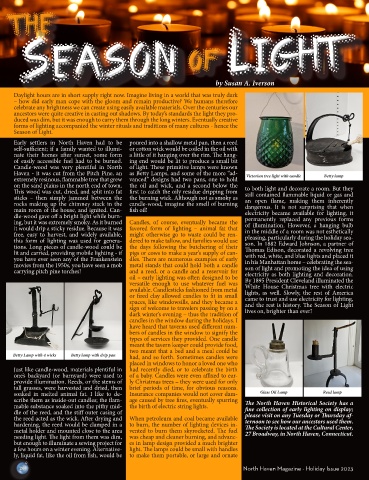
      Early settlers in North Haven had to be  poured into a shallow metal pan, then a reed
      self-sufficient; if a family wanted to illumi-  or cotton wick would be coiled in the oil with
      nate  their  homes after sunset,  some form  a little of it hanging over the rim. The hang-
      of easily accessible fuel had to be burned.  ing end would be lit to produce a small bit
      Candle-wood was very plentiful in North  of light. These primitive lamps were known
      Haven - it was cut from the Pitch Pine, an  as Betty Lamps, and some of the more “ad-  Victorian tree light with candle  Betty lamp
      extremely resinous, flammable tree that grew  vanced” designs had two pans, one to hold
      on the sand plains in the north end of town.  the oil and wick, and a second below the   to both light and decorate a room. But they
      This wood was cut, dried, and split into fat  first to catch the oily residue dripping from   still contained flammable liquid or gas and
      sticks – then simply jammed between the  the burning wick. Although not as smoky as   an  open  flame,  making  them  inherently
      rocks making up the chimney stack in the  candle-wood, imagine the smell of burning   dangerous. It is not surprising that when
      main room of the house, and ignited. Can-  fish oil!                       electricity became available for lighting, it
      dle-wood gave off a bright light while burn-                               permanently replaced any previous forms
      ing, but it was extremely smoky. As it burned  Candles, of course, eventually became the   of illumination. However, a hanging bulb
      it would drip a sticky residue. Because it was  favored form of lighting – animal fat that   in the middle of a room was not esthetically
      free,  easy  to harvest, and  widely  available,  might otherwise go to waste could be ren-  pleasing, particularly during the holiday sea-
      this form of lighting was used for genera-  dered to make tallow, and families would use   son. In 1882 Edward Johnson, a partner of
      tions. Long pieces of candle-wood could be  the days following the butchering of their   Thomas Edison, decorated a revolving tree
      lit and carried, providing mobile lighting - if  pigs or cows to make a year’s supply of can-  with red, white, and blue lights and placed it
      you have ever seen any of the Frankenstein  dles. There are numerous examples of early   in his Manhattan home – celebrating the sea-
      movies from the 1950s, you have seen a mob  metal stands that could hold both a candle   son of light and promoting the idea of using
      carrying pitch pine torches!         and a reed, or a candle and a reservoir for   electricity as both lighting and decoration.
                                           oil – early lighting was often designed to be   By 1895 President Cleveland illuminated the
                                           versatile enough to use whatever fuel was   White House Christmas tree with electric
                                           available. Candlesticks fashioned from metal   lights, as well. Slowly, the rest of America
                                           or fired clay allowed candles to fit in small   came to trust and use electricity for lighting,
                                           spaces, like windowsills, and they became a   and the rest is history. The Season of Light
                                           sign of welcome to travelers passing by on a   lives on, brighter than ever!
                                           dark winter’s evening – thus the tradition of
                                           candles in the window during the holidays. I
                                           have heard that taverns used different num-
                                           bers of candles in the window to signify the
                                           types of services they provided. One candle
                                           meant the tavern keeper could provide food,
                                           two meant that a bed and a meal could be
     Betty Lamp with 4 wicks  Betty lamp with drip pan  had, and so forth. Sometimes candles were
                                           placed in windows to honor a loved one who
      Just like candle-wood, materials plentiful in  had recently died, or to celebrate the birth
      one’s  backyard (or barnyard)  were  used  to  of a baby. Candles were even affixed to ear-
      provide illumination. Reeds, or the stems of  ly Christmas trees – they were used for only
      tall grasses, were harvested and dried, then  brief periods of time, for obvious reasons.
      soaked in melted animal fat. I like to de-  Insurance companies would not cover dam-  Glass Oil Lamp  Reed lamp
      scribe them as inside-out candles; the flam-  age caused by tree fires, eventually spurring   The North Haven Historical Society has a
      mable substance soaked into the pithy mid-  the birth of electric string lights.   fine collection of early lighting on display;
      dle of the reed, and the stiff outer casing of                             please visit on any Tuesday or Thursday af-
      the reed acted as the wick. After drying and  When petroleum and coal became available   ternoon to see how our ancestors used them.
      hardening, the reed would be clamped in a  to burn, the number of lighting devices in-  The Society is located at the Cultural Center,
      metal holder and mounted close to the area  vented to burn them skyrocketed. The fuel   27 Broadway, in North Haven, Connecticut.
      needing light. The light from them was dim,  was cheap and cleaner burning, and advanc-
      but enough to illuminate a sewing project for  es in lamp design provided a much brighter
      a few hours on a winter evening. Alternative-  light. The lamps could be small with handles
      ly, liquid fat, like the oil from fish, would be  to make them portable, or large and ornate

       26                                                                        North Haven Magazine - Holiday Issue 2023

