


Page 33 - North Haven Magazine Issue 27 Winter 2023
P. 33
There are a variety of opinions on the use of wood for smok-  Avoid wood that has been painted, stained, or varnished.
       ing and the best procedures to follow. One area of controver-
       sy  is  whether  to  pre-soak  wood  or  not.  While  some  suggest   Avoid scaffold boards, pallet wood, plywood — They are of-
       pre-soaking will allow wood chips to last longer, others state that   ten  chemically  treated,  but  also  may  have  been  in  contact
       pre-soaking delays the actual production of smoke. Wet wood   with all sorts of unknown substances and chemicals.
       must go through evaporation and dehydration before smoke can   Avoid  wood  with  rot,  mold,  or  fungus.  Burning  can  create
       be produced. During these first stages, all that happens is the   smoke with toxins.
       water evaporates and produces steam, not smoke, and the wood   Avoid wood that has been in contact with poison ivy or any-
       dries out so it can begin to burn and produce smoke.
                                                                  thing  similar  which  can  give  off  (severely)  irritating  vapors
                                                                  when burned.
                                                                  Avoid wood with any kind of ‘off’ or weird smell.’ When you
                                                                  burn it, it will transfer to your food.
                                                                  Avoid  wood  of  which  you  don’t  know  the  species.  It’s  not
                                                                  worth the gamble!

                                                               This information focuses on the role of the woods used in smok-
                                                               ing food. There is a lot more to learn before you light that fire! Be
                                                               sure to compare different types of equipment for smoking, and
                                                               when it is best to use slow cooking over the heat versus using a
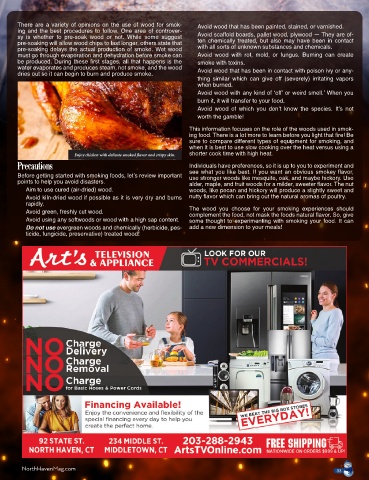
                         Enjoy chicken with delicate smoked flavor and crispy skin.  shorter cook time with high heat.
       Precautions                                             Individuals have preferences, so it is up to you to experiment and
       Before getting started with smoking foods, let’s review important   see what you like best. If you want an obvious smokey flavor,
                                                               use stronger woods like mesquite, oak, and maybe hickory. Use
       points to help you avoid disasters.                     alder, maple, and fruit woods for a milder, sweeter flavor. The nut
         Aim to use cured (air-dried) wood.                    woods, like pecan and hickory will produce a slightly sweet and
         Avoid kiln-dried wood if possible as it is very dry and burns   nutty flavor which can bring out the natural aromas of poultry.
         rapidly.
         Avoid green, freshly cut wood.                        The  wood  you  choose  for  your  smoking  experiences  should
                                                               complement the food, not mask the foods natural flavor. So, give
         Avoid using any softwoods or wood with a high sap content.  some thought to experimenting with smoking your food. It can
         Do not use evergreen woods and chemically (herbicide, pes-  add a new dimension to your meals!
         ticide, fungicide, preservative) treated wood!


        NorthHavenMag.com                                                                                      33

