


Page 14 - North Haven Magazine Issue 27 Winter 2023
P. 14
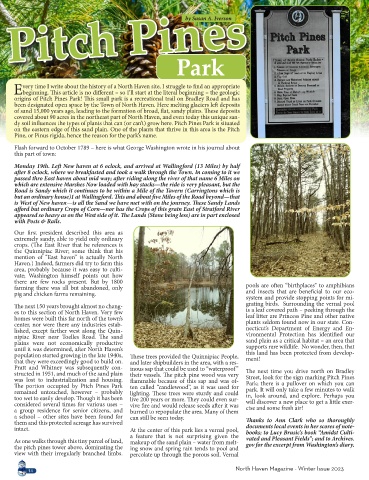
Pitch Pines
    Pitch Pines
                                                              by Susan A. Iverson


                                                           Park


        very time I write about the history of a North Haven site, I struggle to find an appropriate
      Ebeginning. This article is no different – so I’ll start at the literal beginning – the geologic
      origins of Pitch Pines Park! This small park is a recreational trail on Bradley Road and has
      been designated open space by the Town of North Haven. Here melting glaciers left deposits
      of sand 15,000 years ago, leading to the formation of broad, flat, sandy plains. These deposits
      covered about 90 acres in the northeast part of North Haven, and even today this unique san-
      dy soil influences the types of plants that can (or can’t) grow here. Pitch Pines Park is situated
      on the eastern edge of this sand plain. One of the plants that thrive in this area is the Pitch
      Pine, or Pinus rigida, hence the reason for the park’s name.
      Flash forward to October 1789 – here is what George Washington wrote in his journal about
      this part of town:

      Monday 19th. Left New haven at 6 oclock, and arrived at Wallingford (13 Miles) by half
      after 8 oclock, where we breakfasted and took a walk through the Town. In coming to it we
      passed thro East haven about mid way; after riding along the river of that name 6 Miles on
      which are extensive Marshes Now loaded with hay stacks—the ride is very pleasant, but the
      Road is Sandy which it continues to be within a Mile of the Tavern (Carringtons which is
      but an ordinary house)1 at Wallingford. This and about five Miles of the Road beyond—that
      is West of New haven—is all the Sand we have met with on the journey. These Sandy Lands
      afford but ordinary Crops of Corn—nor has the Crops of this grain East of Stratford River
      appeared so heavy as on the West side of it. The Lands (Stone being less) are in part enclosed
      with Posts & Rails.

      Our first president described this area as
      extremely sandy, able to yield only ordinary
      crops. (The East River that he references is
      the Quinnipiac River; some think that his
      mention of “East haven” is actually North
      Haven.) Indeed, farmers did try to farm this
      area, probably because it was easy to culti-
      vate; Washington himself points out how
      there are few rocks present. But by 1800                                   pools are often “birthplaces” to amphibians
      farming there was all but abandoned, only                                  and insects that are beneficial to our eco-
      pig and chicken farms remaining.
                                                                                 system and provide stopping points for mi-
      The next 150 years brought almost no chang-                                grating birds.  Surrounding the vernal pool
                                                                                 is a leaf covered path – peeking through the
      es to this section of North Haven. Very few                                leaf litter are Princess Pine and other native
      homes were built this far north of the town’s                              plants seldom found now in our state. Con-
      center, nor were there any industries estab-                               necticut’s Department of Energy and En-
      lished, except farther west along the Quin-                                vironmental Protection has identified our
      nipiac River near Toelles Road. The sand                                   sand plain as a critical habitat – an area that
      plains  were not  economically productive                                  supports rare wildlife.  No wonder, then, that
      until it was determined, after North Haven’s                               this land has been protected from develop-
      population started growing in the late 1940s,  These trees provided the Quinnipiac People,   ment!
      that they were exceedingly good to build on.  and later shipbuilders in the area, with a res-
      Pratt and Whitney was subsequently con-  inous sap that could be used to “waterproof”   The next time you drive north on Bradley
      structed in 1951, and much of the sand plain  their vessels. The pitch pine wood was very   Street, look for the sign marking Pitch Pines
      was  lost  to  industrialization  and  housing.  flammable because of this sap and was of-  Park; there is a pullover on which you can
      The portion occupied by Pitch Pines Park  ten called “candlewood”, as it was used for   park. It will only take a few minutes to walk
      remained untouched, however – probably  lighting. These trees were sturdy and could   in, look around, and explore. Perhaps you
      too wet to easily develop. Though it has been  live 200 years or more. They could even sur-  will discover a new place to get a little exer-
      considered several times for various uses –  vive fire and would release seeds after it was   cise and some fresh air!
      a group residence for senior citizens, and  burned to repopulate the area. Many of them
      a school – other sites have been found for  can still be seen today.       Thanks to Ann Clark who so thoroughly
      them and this protected acreage has survived                               documents local events in her scores of note-
      intact.                               At the center of this park lies a vernal pool,   books; to Lucy Brusic’s book “Amidst Culti-
                                            a feature that is not surprising given the   vated and Pleasant Fields”; and to Archives.
      As one walks through this tiny parcel of land,  makeup of the sand plain – water from melt-  gov for the excerpt from Washington’s diary.
      the pitch pines tower above, dominating the  ing snow and spring rain tends to pool and
      view with their irregularly branched limbs.  percolate up through the porous soil. Vernal

                                                                              North Haven Magazine - Winter Issue 2023
          14

