


Page 6 - North Haven Magazine Issue 24 Summer 2022
P. 6
Can I Eat That
         Flower?


                                           by Sally Brockett
        Flowers are used to decorate many things, including rooms,
        events, clothing, hair, table settings, and even food on dinner
        plates. Do you usually push aside the flower decorating your
        plate? Have you ever considering eating it? When dining out,
        whatever is on your plate should be edible, so you might like
        to try tasting that pretty flower! The following information
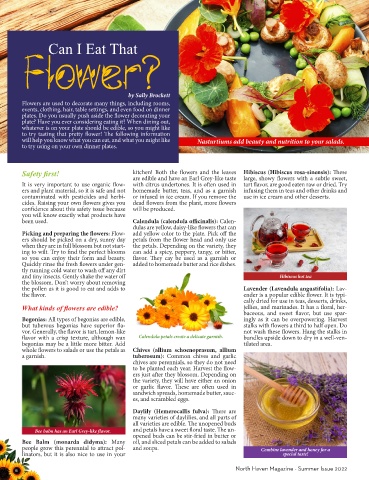
        will help you know what you can eat, and what you might like   Nasturtiums add beauty and nutrition to your salads.
        to try using on your own dinner plates.


        Safety first!                       kitchen! Both the flowers and the leaves  Hibiscus (Hibiscus rosa-sinensis): These
                                            are edible and have an Earl Grey-like taste  large, showy flowers with a subtle sweet,
        It is very important to use organic flow-  with citrus undertones. It is often used in  tart flavor, are good eaten raw or dried. Try
        ers and plant material, so it is safe and not  homemade butter, teas, and as a garnish  infusing them in teas and other drinks and
        contaminated with pesticides and herbi-  or infused in ice cream. If you remove the  use in ice cream and other desserts.
        cides. Raising your own flowers gives you  dead flowers from the plant, more flowers
        confidence about this safety issue because  will be produced.
        you will know exactly what products have
        been used.                          Calendula (calendula officinalis): Calen-
                                            dulas are yellow, daisy-like flowers that can
        Picking and preparing the flowers: Flow-  add yellow color to the plate. Pick off the
        ers should be picked on a dry, sunny day  petals from the flower head and only use
        when they are in full blossom but not start-  the petals. Depending on the variety, they
        ing to wilt. Try to find the perfect blooms  can add a spicy, peppery, tangy, or bitter,
        so  you  can  enjoy  their  form  and  beauty.  flavor. They cay be used as a garnish or
        Quickly rinse the fresh flowers under gen-  added to homemade butter and rice dishes.
        tly running cold water to wash off any dirt
        and tiny insects. Gently shake the water off                                        Hibiscus hot tea
        the blossom. Don’t worry about removing
        the pollen as it is good to eat and adds to                              Lavender (Lavendula angustifolia): Lav-
        the flavor.                                                              ender is a popular edible flower. It is typi-
                                                                                 cally dried for use in teas, desserts, drinks,
        What kinds of flowers are edible?                                        jellies, and marinades. It has a floral, her-
                                                                                 baceous,  and  sweet  flavor,  but  use  spar-
        Begonias: All types of begonias are edible,                              ingly as it can be overpowering. Harvest
        but tuberous begonias have superior fla-                                 stalks with flowers a third to half open. Do
        vor. Generally, the flavor is tart, lemon-like                           not wash these flowers. Hang the stalks in
        flavor with a crisp texture, although wax   Calendula petals create a delicate garnish.  bundles upside down to dry in a well-ven-
        begonias may be a little more bitter. Add                                tilated area.
        whole flowers to salads or use the petals as  Chives (allium schoenoprasum, allium
        a garnish.                          tuberosum):  Common  chives  and  garlic
                                            chives are perennials, so they do not need
                                            to be planted each year. Harvest the flow-
                                            ers just after they blossom. Depending on
                                            the variety, they will have either an onion
                                            or garlic flavor. These are often used in
                                            sandwich spreads, homemade butter, sauc-
                                            es, and scrambled eggs.

                                            Daylily  (Hemerocallis fulva): There are
                                            many varieties of daylilies, and all parts of
                                            all varieties are edible. The unopened buds
            Bee balm has an Earl Grey-like flavor.  and petals have a sweet floral taste. The un-
                                            opened buds can be stir-fried in butter or
        Bee Balm (monarda didyma): Many  oil, and sliced petals can be added to salads
        people grow this perennial to attract pol-  and soups.                        Combine lavender and honey for a
        linators, but it is also nice to use in your                                         special taste!

                                                                              North Haven Magazine - Summer Issue 2022
      6

