


Page 14 - North Haven Magazine Issue 23 Spring 2022
P. 14
by Susan A. Iverson
     BROCKSIEPER’S
    BROCKSIEPER’S
     BROCKSIEPER’S


           Good Time Garden
           Good Time Garden


      By now we’re all longing to stretch our winter-weary limbs in the fresh spring air. So it has al-
      ways been, especially in early 20th century North Haven, where life was not so labor intensive,
      and there was little else to do for entertainment. Three sisters devised a highly creative way to
      pass the time outdoors and entertain their friends. Here is their story…
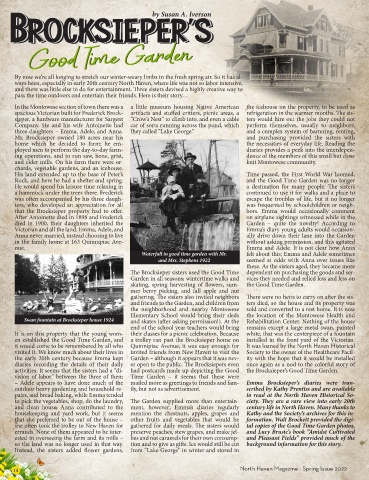
      In the Montowese section of town there was a  a little museum housing Native American  the icehouse on the property, to be used as
      spacious Victorian built for Frederick Brock-  artifacts and stuffed critters, picnic areas, a  refrigeration in the warmer months. The sis-
      sieper, a hardware manufacturer for Sargent  “Crow’s Nest” to climb into, and even a cable  ters would hire out the jobs they could not
      Company. He and his wife Antoinette had  car of sorts running across the pond, which  perform themselves, usually to neighbors,
      three daughters – Emma, Adele, and Anna.  they called “Lake George.”        and a complex system of bartering, renting,
      Mr. Brocksieper owned 180 acres near his                                    and purchasing provided the sisters with
      home which he decided to farm; he em-                                       the necessities of everyday life. Reading the
      ployed men to perform the day-to-day farm-                                  diaries provides a peek into the interdepen-
      ing operations, and to run saw, bone, grist,                                dence of the members of this small but close
      and cider mills. On his farm there were or-                                 knit Montowese community.
      chards, vegetable gardens, and an icehouse.
      His land extended up to the base of Peter’s                                 Time passed, the First World War loomed,
      Rock, and here he had a shelter and spring.                                 and the Good Time Garden was no longer
      He would spend his leisure time relaxing in                                 a destination for many people. The sisters
      a hammock under the trees there. Frederick                                  continued to use it for walks and a place to
      was often accompanied by his three daugh-                                   escape the troubles of life, but it no longer
      ters, who developed an appreciation for all                                 was frequented by schoolchildren or neigh-
      that  the Brocksieper  property  had to  offer.                             bors. Emma would occasionally comment
      After Antoinette died in 1898 and Frederick                                 on airplane sightings witnessed while in the
      died in 1900, their daughters inherited the                                 Garden  –  quite  the novelty! According  to
      Victorian and all the land. Emma, Adele, and                                Emma’s diary young adults would occasion-
      Anna never married, instead choosing to live                                ally drive down their lane into the Garden
      in the family home at 163 Quinnipiac Ave-                                   without asking permission, and this agitated
      nue.                                                                        Emma and Adele. It is not clear how Anna
                                               Waterfall in good time garden with Mr.   felt about this; Emma and Adele sometimes
                                                     and Mrs. Stephens 1922       seemed at odds with Anna over issues like
                                                                                  these. As the sisters aged, they became more
                                            The Brocksieper sisters used the Good Time  dependent on purchasing the goods and ser-
                                            Garden in all seasons; wintertime walks and  vices they needed and relied less and less on
                                            skating, spring harvesting of flowers, sum-  the Good Time Garden.
                                            mer berry picking, and fall apple and nut
                                            gathering. The sisters also invited neighbors  There were no heirs to carry on after the sis-
                                            and friends to the Garden, and children from  ters died, so the house and its property was
                                            the neighborhood and nearby Montowese  sold and converted to a rest home. It is now
                                            Elementary School would bring their sleds  the location of the Montowese Health and
         Swan fountain at Brocksieper house 1924  and skates (after asking permission!). At the  Rehabilitation Center. Nothing of the house
                                            end of the school year teachers would bring  remains except a large metal swan, painted
      It is on this property that the young wom-  their classes for a picnic celebration. Because  white, that was the centerpiece of a fountain
      en established the Good Time Garden, and  a trolley ran past the Brocksieper home on  installed in the front yard of the Victorian.
      it would come to be remembered by all who  Quinnipiac Avenue, it was easy enough for  It was loaned by the North Haven Historical
      visited it. We know much about their lives in  invited friends from New Haven to visit the  Society to the owner of the Healthcare Facil-
      the early 20th century because Emma kept  Garden – although it appears that it was nev-  ity with the hope that it would be installed
      diaries recording the details of their daily  er open to the public. The Brocksiepers even  once again as a nod to the colorful story of
      activities. It seems that the sisters had a “di-  had postcards made up depicting the Good  the Brocksieper’s Good Time Garden.
      vision of labor” between the three of them  Time Garden – it  seems that these were
      – Adele appears to have done much of the  mailed more as greetings to friends and fam-  Emma Brocksieper’s diaries were tran-
      outdoor heavy gardening and household re-  ily, but not as advertisement.   scribed by Kathy Prentiss and are available
      pairs, and bread baking, while Emma tended                                  to read at the North Haven Historical So-
      to pick the vegetables, shop, do the laundry,  The Garden supplied more than entertain-  ciety. They are a rare view into early 20th
      and clean house. Anna contributed to the  ment, however; Emma’s diaries regularly  century life in North Haven. Many thanks to
      housekeeping and yard work, but it seems  mention  the  chestnuts,  apples,  grapes  and  Kathy and the Society’s archives for this in-
      that she preferred to be out of the house –  other fruits and vegetables that would be  formation. Walt Brockett provided the digi-
      she often took the trolley to New Haven for  gathered for daily meals. The sisters would  tal copies of the Good Time Garden photos,
      errands. None of them appeared to be inter-  preserve peaches, stew grapes, and make jel-  and Lucy Brusic’s book “Amidst Cultivated
      ested in overseeing the farm and its mills –  lies and nut caramels for their own consump-  and Pleasant Fields” provided much of the
      so the land was no longer used in that way.  tion and to give as gifts. Ice would still be cut  background information for this story.
      Instead, the sisters added flower gardens,  from “Lake George” in winter and stored in


                                                                               North Haven Magazine - Spring Issue 2022
     14

