


Page 14 - North Haven Magazine Issue 22 Winter 2022
P. 14
by Susan A. Iverson
                               North Haven's First


                         INHABITANTS


                      Before the Europeans visited and settled in the North Haven area, the Quinnipiac people lived in this
                      region. North Haven did not have boundaries as we know them today. Rather, it was part of a much
                      larger area dominated by the Quinnipiac River and so became inhabited by a people who depended
                      on the river for many of its resources. We need to think of our town in a much different context – an
                      exceedingly small part of the continent of North America with a specific climate, growing conditions,
                      and supplies of plants and animals that a group of humans came to be dependent on for survival.
                      The Quinnipiac People acclimated to this part of our continent – they were North Haven’s first in-
                      habitants.
        ccording to Lucy Brusic’s book  Among  tein they needed in their diets. They also used
     ACultivated and Pleasant Fields the first  the waste shells from oysters, clams, and scal-
     visitors to North Haven arrived about 14,000  lops as tools for fishing, scooping, and digging
     years ago and used this area for hunting and  soil while gardening. The winter months pro-
     fishing.  Evidence  of  more  permanent  settle-  vided much better hunting a bit upland, mak-
     ments in North Haven can be traced back  ing North Haven an ideal location for them.
     about 2,500 years – and were likely ancestors  The  animals  they  hunted  in  North  Haven
     of the Quinnipiac People. When Dutch ex-  provided them with heavier fur and thicker
     plorers arrived in New Haven Harbor in 1625,  layers of fat in the winter months, making it a
     they were met by a people the Dutch came to  superior winter home. Because the Quinnip-
     call the “Quirepays”, or Quinnipiacs, after the  iacs were constantly moving about gathering
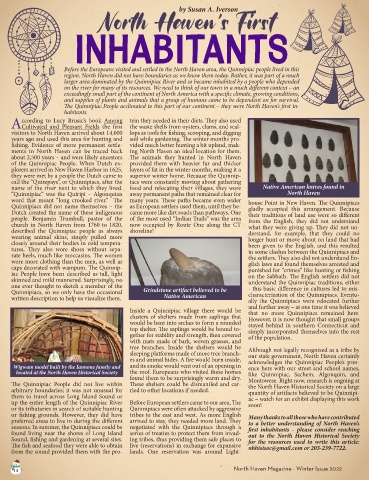
     name  of the river next  to which they lived.  food and relocating their villages, they wore   Native American knives found in
     “Quinnipiac” was the Quiripi – Algonquian  away permanent paths that remained clear for   North Haven
     word  that  meant  “long  crooked  river.”    The  many years. These paths became even wider   house Point in New Haven. The Quinnipiacs
     Quinnipiacs did not name themselves – the  as European settlers used them, until they be-  gladly accepted  this arrangement. Because
     Dutch created the name of these indigenous  came more like dirt roads than pathways. One   their traditions of land use were so different
     people. Benjamin Trumbull, pastor of the  of the most used “Indian Trails” was the area   from the English, they did not understand
     church in North Haven from 1760 to 1820,  now  occupied  by  Route  One  along  the  CT   what they were giving up. They did not un-
     described the Quinnipiac people as always  shoreline!                        derstand, for example, that they could no
     wearing animal skins, simply pulled more                                     longer hunt or move about on land that had
     closely around their bodies in cold tempera-                                 been given to the English, and this resulted
     tures. They also wore shoes without sepa-                                    in some clashes between the Quinnipiacs and
     rate heels, much like moccasins. The women                                   the settlers. They also did not understand En-
     wore more clothing than the men, as well as                                  glish laws and found themselves arrested and
     caps decorated with wampum. The Quinnip-                                     punished for “crimes” like hunting or fishing
     iac People have been described as tall, light                                on the Sabbath. The English settlers did not
     skinned and mild mannered. Surprisingly, no                                  understand the Quinnipiac traditions, either
     one ever thought to sketch a member of the                                   - this basic difference in cultures led to mis-
     Quinnipiacs, so we only have the occasional   Grindstone artifact believed to be  characterization of the Quinnipiacs. Eventu-
     written description to help us visualize them.    Native American            ally the Quinnipiacs were relocated further
                                           Inside a Quinnipiac village there would be   and further away – at one time it was believed
                                                                                  that no more Quinnipiacs remained here.
                                           clusters of shelters made from saplings that   However, it is now thought that small groups
                                           would be bent into arches to form a rounded   stayed  behind  in  southern  Connecticut  and
                                           top shelter. The saplings would be bound to-  simply incorporated themselves into the rest
                                           gether for stability and strength, then covered   of the population.
                                           with mats made of bark, woven grasses, and
                                           tree branches. Inside the shelters would be   Although not legally recognized as a tribe by
                                           sleeping platforms made of more tree branch-  our state government, North Haven certainly
                                           es and animal hides. A fire would burn inside,   acknowledges the Quinnipiac People’s pres-
     Wigwam model built by the Iannone family and   and its smoke would vent out of an opening in   ence here with our street and school names,
      located at the North Haven Historical Society  the roof. Europeans who visited these homes   like  Quinnipiac, Sachem,  Algonquin,  and
                                           found them to be surprisingly warm and dry.   Montowese. Right now, research is ongoing at
     The Quinnipiac People did not live within  These shelters could be dismantled and car-  the North Haven Historical Society on a large
     arbitrary boundaries; it was not unusual for  ried to other locations if needed.   quantity of artifacts believed to be Quinnipi-
     them to travel across Long Island Sound or                                   ac – watch for an exhibit displaying this work
     up the entire length of the Quinnipiac River  Before European settlers came to our area, The   soon!
     or its tributaries in search of suitable hunting  Quinnipiacs were often attacked by aggressive
     or fishing grounds. However, they did have  tribes to the east and west. As more English   Many thanks to all those who have contributed
     preferred areas to live in during the different  arrived to stay, they needed more land. They   to a better understanding of North Haven’s
     seasons. In summer, the Quinnipiacs could be  negotiated with the Quinnipiacs through a   first inhabitants – please consider reaching
     found living near the shores of Long Island  series of treaties to protect them from invad-  out to the North Haven Historical Society
     Sound, fishing and gardening at several sites.  ing tribes, thus providing them safe places to   for  the  resources  used  to  write  this  article:
     The fish and seafood they were able to obtain  live (reservations) in exchange for expansive   [email protected] or 203-239-7722.
     from the sound provided them with the pro-  lands.  One  reservation  was  around  Light-


                                                                             North Haven Magazine - Winter Issue 2022
     14

