


Page 10 - North Haven Magazine Spring 2021 Issue 18
P. 10
A FARMER’SARMER’S
      A F                                            by Susan A. Iverson
      MEMORIES
      MEMORIES


      Part I - From Subsistence to Prosperity

      I always ask Jill (our editor) what she would like me to write about.  For this issue of North
      Haven Magazine, she suggested I write about the first farm in town.  When North Haven
      was incorporated in 1786 everyone was a farmer of sorts.  Farms were simply places where
      you grew the food and other goods your family required to survive – we call it subsistence
      farming now.  I chose to write about the Brockett Farm – Richard (Dick) Brockett had written
      down dozens of memories of the farm and the ancestors who had worked it since 1799.  By
      the time I finished reading all that he had recorded I felt I knew him like my neighbor and
      am thankful we have his life’s experiences preserved as part of our town’s history.  There is so
      much to describe about this farm that I have written two parts; the second part will appear
      in the next edition.
      It is stated in Richard Brockett’s reminis-  became available, the water pump was pow-
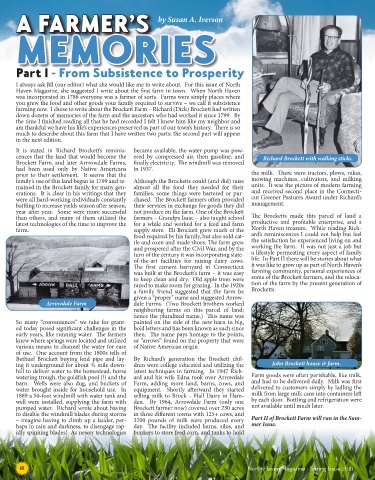
      cences that the land that would become the  ered by compressed air, then gasoline, and   Richard Brockett with walking sticks.
      Brockett Farm, and later Arrrowdale Farms,  finally electricity.  The windmill was removed
      had been used only by Native Americans  in 1937.
      prior to their settlement.  It seems that the                                the milk.  There were tractors, plows, rakes,
      family’s use of this land began in 1799 and re-  Although the Brocketts could (and did) raise   mowing machines, cultivators, and milking
      mained in the Brockett family for many gen-  almost all the food they needed for their   units.  It was the picture of modern farming
      erations.  It is clear in his writings that they  families, some things were bartered or pur-  and received second place in the Connecti-
      were all hard-working individuals constantly  chased.  The Brockett farmers often provided   cut Greener Pastures Award under Richard’s
      battling to increase yields season after season,  their services in exchange for goods they did   management.
      year after year.  Some were more successful  not produce on the farm. One of the Brockett
      than others, and many of them utilized the  farmers – Grandpa Isaac – also taught school   The Brocketts made this parcel of land a
      latest technologies of the time to improve the  for a while and worked for a feed and farm   productive and profitable enterprise, and a
      farm.                                  supply store.  Eli Brockett grew much of the   North Haven treasure.  While reading Rich-
                                             food required by his family, but also sold cat-  ard’s reminiscences I could not help but feel
                                             tle and oxen and made shoes. The farm grew   the satisfaction he experienced living on and
                                             and prospered after the Civil War, and by the   working the farm.  It was not just a job but
                                             turn of the century it was incorporating state-  a lifestyle permeating every aspect of family
                                             of-the-art facilities for raising dairy cows.    life.  In Part II there will be stories about what
                                             The first cement barnyard in Connecticut   it was like to grow up as part of North Haven’s
                                             was built at the Brockett’s farm – it was easy   farming community, personal experiences of
                                             to keep clean and dry.  Old apple trees were   some of the Brockett farmers, and the reloca-
                                             razed to make room for grazing.  In the 1920s   tion of the farm by the present generation of
                                             a family friend suggested that the farm be   Brocketts.
                                             given a “proper” name and suggested Arrow-
                Arrowdale Farm               dale Farms.  (Two Brockett brothers worked
                                             neighboring farms on this parcel of land;
                                             hence the pluralized name.)  This name was
      So many “conveniences” we take for grant-  painted on the side of the new barn in big,
      ed today posed significant challenges in the  bold letters and has been known as such since
      early years, like running water.  The farmers  then.  The name pays homage to the points,
      knew where springs were located and utilized  or “arrows” found on the property that were
      various means to channel the water for ease  of Native American origin.
      of use.  One account from the 1800s tells of
      Bethuel Brockett buying lead pipe and lay-  By Richard’s generation the Brockett chil-
      ing it underground for about ¾ mile down-  dren were college educated and utilizing the   John Brockett house & farm.
      hill to deliver water to the homestead, horse  latest techniques in farming.  In 1947 Rich-
      watering trough, the goldfish pool (!) and the  ard and his wife Edna took over Arrowdale   Farm goods were often perishable, like milk,
      barn.  Wells were also dug, and buckets of  Farm, adding more land, barns, cows, and   and had to be delivered daily.  Milk was first
      water brought inside for household use.  In  equipment.  Shortly afterward they started   delivered to customers simply by ladling the
      1889 a 50-foot windmill with water tank and  selling milk to Brock – Hall Dairy in Ham-  milk from large milk cans into containers left
      well were installed, supplying the farm with  den.  By 1964, Arrowdale Farm (only one   by each door.  Bottling and refrigeration were
      pumped water.  Richard wrote about having  Brockett farmer now) covered over 230 acres   not available until much later.
      to disable the windmill blades during storms  in three different towns with 125+ cows, and
      – imagine having to climb up a ladder, per-  3200 pounds of milk were produced every   Part II of Brockett Farm will run in the Sum-
      haps in rain and darkness, to disengage rap-  day.  The facility included barns, silos, and   mer Issue.
      idly spinning blades!  As newer technologies  bunkers to store feed corn, and tanks to hold


        10                                                                        North Haven Magazine - Spring Issue 2021

