


Page 10 - North Haven Magazine Issue 16 Holiday 2020
P. 10
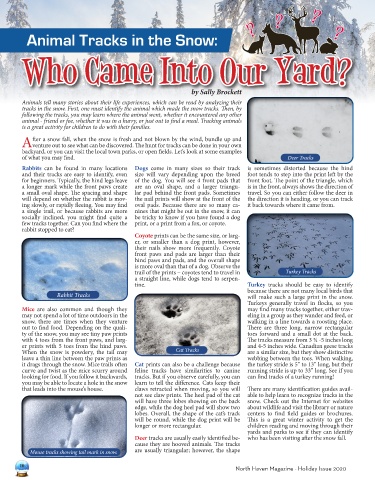
Who Came Into Our Yard?
        Who Came Into Our Yard?


                                                               by Sally Brockett
        Animals tell many stories about their life experiences, which can be read by analyzing their
        tracks in the snow. First, one must identify the animal which made the snow tracks. Then, by
        following the tracks, you may learn where the animal went, whether it encountered any other
        animal - friend or foe, whether it was in a hurry, or just out to find a meal. Tracking animals
        is a great activity for children to do with their families.

            fter a snow fall, when the snow is fresh and not blown by the wind, bundle up and
        Aventure out to see what can be discovered. The hunt for tracks can be done in your own
        backyard, or you can visit the local town parks, or open fields. Let’s look at some examples
        of what you may find.                                                                  Deer Tracks

        Rabbits can be found in many locations  Dogs come in many sizes so their track  is sometimes distorted because the hind
        and their tracks are easy to identify, even  size will vary depending upon the breed  foot tends to step into the print left by the
        for beginners. Typically, the hind legs leave  of the dog. You will see 4 front pads that  front foot. The point of the triangle, which
        a longer mark while the front paws create  are  an  oval  shape,  and  a  larger  triangu-  is in the front, always shows the direction of
        a small oval shape. The spacing and shape  lar pad behind the front pads. Sometimes  travel. So you can either follow the deer in
        will depend on whether the rabbit is mov-  the nail prints will show at the front of the  the direction it is heading, or you can track
        ing slowly, or rapidly fleeing. You may find  oval  pads.  Because  there  are  so  many  ca-  it back towards where it came from.
        a single trail, or because rabbits are more  nines that might be out in the snow, it can
        socially inclined, you might find quite a  be tricky to know if you have found a dog
        few tracks together. Can you find where the  print, or a print from a fox, or coyote.
        rabbit stopped to eat?
                                             Coyote prints can be the same size, or larg-
                                             er, or smaller than a dog print, however,
                                             their nails show more frequently. Coyote
                                             front paws and pads are larger than their
                                             hind paws and pads, and the overall shape
                                             is more oval than that of a dog. Observe the
                                             trail of the prints – coyotes tend to travel in   Turkey Tracks
                                             a straight line, while dogs tend to serpen-
                                             tine.                                Turkey tracks should be easy to identify
                                                                                  because there are not many local birds that
                    Rabbit Tracks                                                 will make such a large print in the snow.
                                                                                  Turkeys  generally travel in  flocks,  so  you
        Mice  are  also  common  and though  they                                 may find many tracks together, either trav-
        may not spend a lot of time outdoors in the                               eling in a group as they wander and feed, or
        snow,  there  are  times  when  they  venture                             walking in a line towards a roosting place.
        out to find food. Depending on the quali-                                 There are three long, narrow rectangular
        ty of the snow, you may see tiny paw prints                               toes forward and a small dot at the back.
        with 4 toes from the front paws, and larg-                                The tracks measure from 3 ¾ -5 inches long
        er prints with 5 toes from the hind paws.                                 and 4-5 inches wide. Canadian geese tracks
        When  the  snow  is  powdery,  the  tail  may     Cat Tracks              are a similar size, but they show distinctive
        leave a thin line between the paw prints as                               webbing between the toes. When walking,
        it drags through the snow. Mice trails often  Cat prints can also be a challenge because  the turkey stride is 5” to 13” long, but their
        curve and twist as the mice scurry around  feline  tracks  have  similarities  to  canine  running stride is up to 33” long. See if you
        looking for food. If you follow it backwards,  tracks. But if you observe carefully, you can  can find tracks of a turkey running!
        you may be able to locate a hole in the snow  learn to tell the difference. Cats keep their
        that leads into the mouse’s house.   claws retracted when moving, so you will  There are many identification guides avail-
                                             not see claw prints. The heel pad of the cat  able to help learn to recognize tracks in the
                                             will have three lobes showing on the back  snow. Check out the Internet for websites
                                             edge, while the dog heel pad will show two  about wildlife and visit the library or nature
                                             lobes. Overall, the shape of the cat’s track  centers to find field guides or brochures.
                                             will be round, while the dog print will be  This is a great winter activity to get the
                                             longer or more rectangular.          children reading and moving through their
                                                                                  yards and parks to see if they can identify
                                             Deer tracks are usually easily identified be-  who has been visiting after the snow fall.
                                             cause they are hooved animals. The tracks
           Mouse tracks showing tail mark in snow.  are usually triangular; however, the shape

       10
                                                                              North Haven Magazine - Holiday Issue 2020

