


Page 7 - North Haven Magazine Issue 39 Summer 2025
P. 7
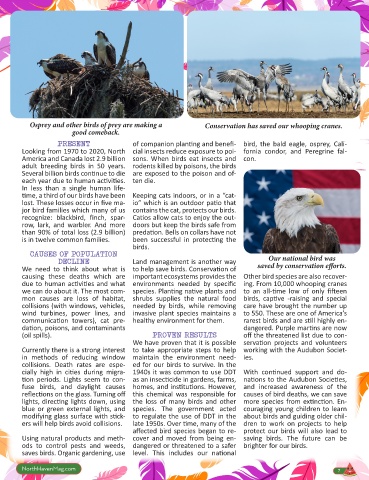
Osprey and other birds of prey are making a              Conservation has saved our whooping cranes.
                         good comeback.
                    PRESENT                 of companion planting and benefi-    bird,  the  bald  eagle,  osprey,  Cali-
        Looking from 1970 to 2020, North  cial insects reduce exposure to poi-   fornia  condor,  and  Peregrine  fal-
        America and Canada lost 2.9 billion  sons.  When birds  eat insects  and  con.
        adult  breeding  birds  in  50  years.  rodents killed by poisons, the birds
        Several billion birds continue to die  are exposed to the poison and of-
        each year due to human activities.  ten die.
        In less than  a single  human life-
        time, a third of our birds have been  Keeping cats indoors, or in a “cat-
        lost. These losses occur in five ma-  io” which is an outdoor patio that
        jor bird families which many of us  contains the cat, protects our birds.
        recognize:  blackbird,  finch,  spar-  Catios allow cats to enjoy the out-
        row,  lark,  and  warbler. And more  doors but keep the birds safe from
        than 90% of total loss (2.9 billion)  predation. Bells on collars have not
        is in twelve common families.       been  successful  in  protecting  the
                                            birds.
           CAUSES OF POPULATION                                                          Our national bird was
                    DECLINE                 Land management is another way
        We need to think  about  what is  to help save birds. Conservation of        saved by conservation efforts.
        causing  these  deaths which  are  important ecosystems provides the  Other bird species are also recover-
        due to human activities and what  environments  needed  by  specific  ing. From 10,000 whooping cranes
        we can do about it. The most com-   species. Planting native plants and  to  an  all-time  low  of  only  fifteen
        mon causes are  loss  of habitat,  shrubs supplies  the natural food  birds,  captive  -raising  and  special
        collisions (with windows, vehicles,  needed by birds, while  removing  care have brought the number up
        wind  turbines, power  lines, and  invasive plant species maintains a  to 550. These are one of America’s
        communication  towers),  cat  pre-  healthy environment for them.        rarest birds and are still highly en-
        dation, poisons, and contaminants                                        dangered. Purple martins are now
        (oil spills).                              PROVEN RESULTS                off the threatened list due to con-
                                            We have proven that it is possible  servation  projects  and  volunteers
        Currently there is a strong interest  to take appropriate steps to help  working with the Audubon Societ-
        in  methods  of reducing window  maintain  the environment need-         ies.
        collisions.  Death  rates are espe-  ed for our birds to survive. In the
        cially  high  in  cities  during  migra-  1940s it was common to use DDT  With  continued  support  and  do-
        tion  periods.  Lights  seem  to  con-  as an insecticide in gardens, farms,  nations to the Audubon Societies,
        fuse birds, and  daylight causes  homes, and institutions. However,  and increased  awareness  of the
        reflections on the glass. Turning off  this  chemical was responsible  for  causes of bird deaths, we can save
        lights, directing lights down, using  the loss of  many birds  and other  more species from extinction. En-
        blue or green external lights, and  species. The government acted  couraging young children to learn
        modifying glass surface with stick-  to regulate the use of DDT in the  about birds and guiding older chil-
        ers will help birds avoid collisions.  late 1950s. Over time, many of the  dren to work on projects to help
                                            affected bird species began to re-   protect our birds will also lead to
        Using natural products and meth-    cover  and  moved from being  en-    saving birds.  The future  can be
        ods  to control  pests and  weeds,  dangered or threatened to a safer  brighter for our birds.
        saves birds. Organic gardening, use  level.  This  includes  our  national


        NorthHavenMag.com                                                                                      7

